Why Swelling Gets Worse With Age - Even If You’re Active
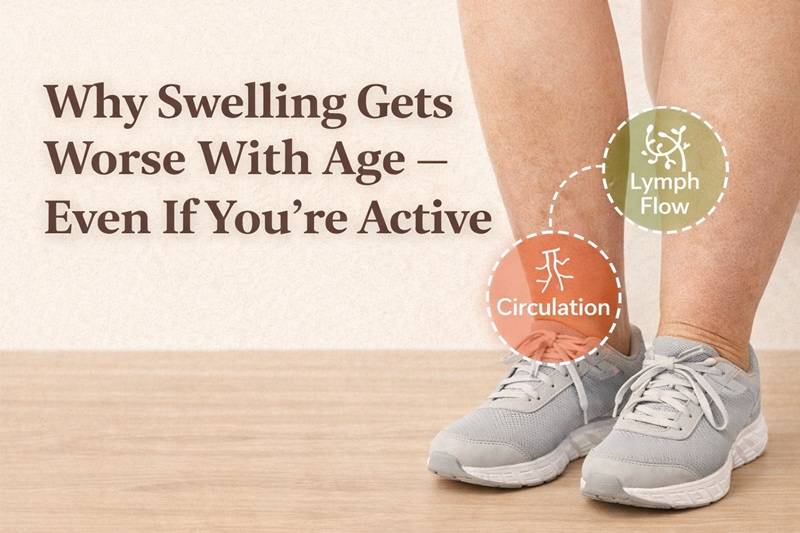
The overlooked circulatory changes that make fluid retention harder to control after 40 -and what actually helps
“But I’m Still Active -Why Am I Swelling?”
A reader once emailed me something that stuck.
“I walk every morning. I drink water. I eat fairly well. But by the end of the day, my ankles look like they belong to someone twice my age. What am I missing?”
It’s a question I hear often — and it highlights a frustrating truth many people discover in their 40s, 50s, and beyond:
Staying active is essential — but it’s no longer enough on its own to prevent swelling.
If you’ve noticed:
- Puffy ankles at night
- Tight shoes by afternoon
- Legs that feel heavy or achy after standing
- Swelling that lingers longer than it used to
You’re not imagining things. And you’re not failing your health.
What’s happening is more subtle — and far more physiological.
The Big Myth: “Swelling Only Happens If You’re Inactive”
For years, swelling has been blamed on:
- Sitting too long
- Being overweight
- Not exercising enough
While those can contribute, age-related swelling follows a different rulebook.
In fact, many people who experience worsening swelling with age are:
- Regular walkers
- Gym-goers
- Yoga or Pilates enthusiasts
- People who “do everything right”
So why does swelling still creep in?
Because aging changes how fluid moves through your body, not just how much you move.
What Actually Changes With Age (That No One Talks About)
1. Circulation Slows — Even in Active People
As we age, blood vessels naturally lose elasticity. Veins become less efficient at pushing blood upward — especially from the legs back to the heart.
This creates a quiet backup system:
- Blood pools slightly longer
- Pressure increases in lower limbs
- Fluid leaks into surrounding tissues
Walking helps — but it doesn’t fully reverse this mechanical slowdown.
This is why many people experience swelling later in the day, not in the morning.
2. The Lymphatic System Becomes Sluggish
Unlike the cardiovascular system, the lymphatic system has no pump. It relies entirely on:
- Muscle contraction
- Hydration
- Gentle pressure and movement
With age:
- Lymph vessels narrow
- Flow becomes less responsive
- Inflammation increases resistance
The result? Excess fluid has nowhere to go.
This is one reason swelling can feel “sticky” — it doesn’t disappear overnight like it used to.
(We explored this more deeply in 10 Natural Remedies to Reduce Swelling, Improve Circulation, and Regain Mobility.)
3. Inflammation Quietly Increases
Aging is associated with low-grade chronic inflammation — sometimes called inflammaging.
This matters because inflammation:
- Makes blood vessels more permeable
- Encourages fluid leakage into tissues
- Slows lymphatic clearance
Even if your joints feel “fine,” inflammation can still be driving subtle swelling beneath the surface.
This helps explain why swelling and stiffness often appear together — a topic we covered in The Hidden Link Between Poor Circulation and Joint Stiffness.
Why Exercise Alone Stops Working the Same Way
Exercise is still essential. But its role changes with age.
In your 20s and 30s:
- Movement alone could flush fluid efficiently
- Recovery was rapid
- Circulation bounced back easily
After 40:
- The system needs support, not just stimulation
- Recovery takes longer
- Fluid clearance becomes less responsive
This is why:
- Long walks help… but don’t fully fix swelling
- Compression socks help… but feel temporary
- Elevation helps… but doesn’t address the root cause
Movement becomes one tool — not the entire solution.
Swelling vs. Fat: Why It’s Easy to Get Confused
One reason age-related swelling is so frustrating is that it often looks like fat gain.
But the two are very different.
| Fluid Retention | Fat |
|---|---|
| Fluctuates daily | Changes slowly |
| Worse at night | Consistent |
| Leaves indent when pressed | Does not |
| Improves with elevation | Does not |
Many people diet harder when the real issue is fluid balance — something we broke down in detail in Fluid Retention vs. Fat: How to Tell the Difference — And Fix the Real Problem.
The Emotional Side No One Mentions
I’ve worked with many health-focused individuals who felt quietly discouraged by swelling.
They’d say things like:
- “I don’t recognize my legs anymore.”
- “My shoes don’t fit the same.”
- “I feel older than I should.”
Swelling affects more than comfort — it affects confidence, mobility, and self-trust.
And when people feel like their efforts aren’t paying off, they often give up — which only worsens the cycle.
The solution isn’t doing more. It’s doing what works for your current physiology.
What Actually Helps Reduce Age-Related Swelling
1. Supporting Venous Return (Not Just Movement)
Gentle activities that promote rhythmic contraction help more than intense workouts alone:
- Walking intervals
- Light resistance movements
- Heel raises
- Slow cycling
Consistency matters more than intensity.
2. Hydration That Supports Fluid Balance
Counterintuitive, but dehydration worsens swelling.
When fluid intake drops:
- The body holds onto sodium
- Tissues retain more water
- Swelling increases
Electrolyte balance matters just as much as water quantity.
3. Reducing Inflammation at the Source
Anti-inflammatory support helps restore vessel integrity and fluid movement:
- Polyphenols
- Herbal compounds
- Antioxidants
This is why many people notice improvement not just in swelling — but in leg comfort and flexibility.
4. Supporting the Lymphatic Pathway
This is the piece most people miss.
The lymphatic system needs:
- Micronutrient support
- Herbal assistance
- Daily consistency
When lymph flow improves, swelling often reduces without extreme measures.
This is where targeted circulation-support supplements can quietly help — not as a replacement for lifestyle habits, but as reinforcement for aging systems that need more assistance than they once did.
Why Results Often Feel “Sudden” When the Right Support Is Added
A pattern I’ve seen repeatedly is this:
People try everything individually:
- Walking
- Diet changes
- Compression
- Elevation
Minimal results.
Then they add the missing physiological support — circulation, lymphatic flow, inflammation control — and suddenly:
- Shoes feel looser
- Ankles look defined again
- Legs feel lighter by evening
It’s not magic. It’s systems working together again.
The Takeaway: Swelling Isn’t a Personal Failure
If swelling has increased with age — even though you’re active — it’s not because you’re doing something wrong.
It’s because:
- Circulation changes
- Lymphatic flow slows
- Inflammation increases
- Fluid balance becomes harder to regulate
The solution isn’t punishment. It’s support.
And when you address the real mechanisms behind swelling, improvement often follows naturally — without extreme diets, overtraining, or frustration.
Closing Thoughts
If you’ve been active, health-conscious, and still dealing with stubborn swelling, this may be your sign to stop blaming effort — and start supporting physiology.
Small, consistent changes — combined with the right circulatory and lymphatic support — can make a meaningful difference in how your legs feel, move, and recover each day.
And for many people, that’s the moment when mobility begins to feel possible again — not forced.